

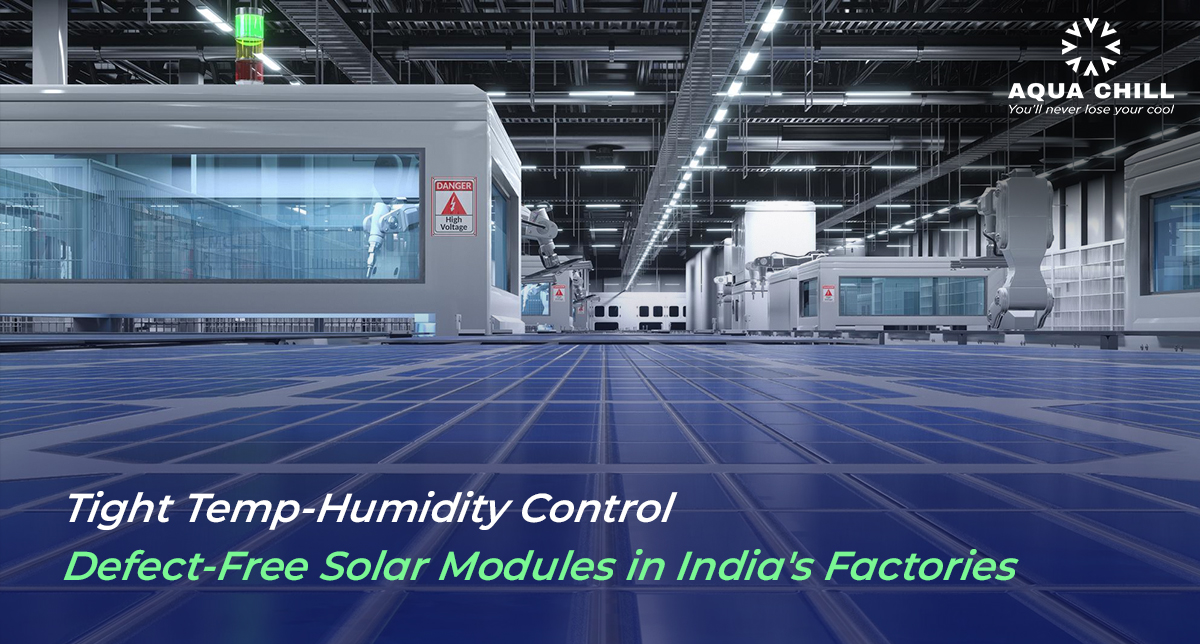
Temperature and humidity control are the foundation for reliable solar module manufacturing, especially in India’s dusty, high-ambient industrial clusters. And so, thoughtfully engineered HVAC, especially around lamination and assembly, prevents defects, stabilizes yields, and safeguards 25-year project IRRs. This is critical as global investors increasingly scrutinize “Made in India” quality.
Why Lamination Demands Climate-Proof HVAC
During the lamination process, EVA or POE encapsulants must follow a precise temperature profile to gel uniformly – bonding glass, cells, and back sheet – into a bubble-free structure. Excess moisture or swings trap micro-bubbles, create un-gelled pockets, or lead to acetic acid formation. These defects manifest as snail trails, corrosion, delamination, or power loss in the field.
India’s field data is proof of this vulnerability: assessments reveal poor lamination and moisture ingress drive defect rates above 8% in some domestic modules. This number far exceeds global peers and can trigger warranty claims in utility projects financed by global lenders.
These issues erode bankability, as even minor early-life failures slash yield estimates and inflate operational costs for solar parks in humid coastal regions.
Target Conditions in Cleanroom PV Lines
IEC 61215 damp-heat tests (85°C, 85% RH for 1,000 hours) expose lamination weaknesses, simulating decades of coastal or monsoon exposure that exploit any residual moisture in bonds.
Leading Indian factories have adopted ISO Class 6–8 cleanrooms for layup, lamination, and assembly, targeting 22–25°C and 30–40% RH to block condensation, ionic contamination, and dust on wafers, encapsulants, and interconnects.
This setup ensures modules withstand thermal-cycling (from -40°C to 85°C) and mechanical stress tests, delivering the reliability demanded by EPC contractors and off-takers in large-scale projects.
HVAC Design for Indian PV Challenges
How does Indian HVAC adapt or cater to these conditions?
India’s 40°C+ summers and 70%+ monsoon humidity demand dedicated air-handling units (AHUs) with dehumidification coils, reheat capabilities, and HEPA/ULPA filtration to handle particulate loads from nearby industrial zones.
Key features include pressure cascades (cleaner air flows to dirtier zones), low-turbulence laminar airflow over layup tables, and smart controls (often PLC/BMS integrated) that balance process exhaust for stable RH despite shift fluctuations or equipment downtime.
Energy efficiency matters too. Variable frequency drives (VFDs) on fans and pumps, plus heat recovery from exhaust, cut operational costs in power-hungry factories while meeting sustainability mandates.

Process-Wide Integration from Layup to Potting
It is clear that HVAC must envelop the full process chain – from glass washing, cell stringing, bussing, and lamination to framing, and junction-box sealing – to avoid moisture spikes or dust settlement that can compromise adhesion.
For example, glass washing in a high-humidity zone followed by slow transfer to layup invites condensation. Airlocks and pass-throughs create a “climate bubble,” minimizing acetic acid in EVA, PID risk, and failures in subsequent tests.
Zoning evolves per step. Think coarser filtration for framing, tighter controls for bussing to shield silver paste from humidity-induced cracking, ensuring consistent quality from raw materials to finished panels.
Impact on Quality, Reliability, and Bankability
Efficient HVAC slashes lamination defects like bubbles, voids, edge delamination, and corrosion, directly boosting first-pass yields and cutting rework by 20-30% in optimized lines.
This reliability shines in IEC quals and extended field trials, reducing PID, hot spots, and insulation breakdowns – vital for 30-year warranties in India’s variable climates.
Financially, it stabilizes batch outputs, trims warranty reserves, and strengthens PPAs with performance guarantees, making modules attractive to REITs and infrastructure funds eyeing 12-15% IRRs.
India’s HVAC Opportunity Amid Tech Shifts
India’s solar boom (targeting 500 GW by 2030) fuels new TOPCon, HJT, and tandem lines, all hypersensitive to moisture and excursions beyond conventional PERC tolerances. Yet rushed capacity additions risk quality pitfalls.
It is no wonder that investors now audit factory HVAC, cleanroom validation, and redundancy during due diligence for gigawatt-scale parks.
Specialized integrators thrive here, delivering turnkey solutions – from CFD-modeled airflow and pressure mapping to commissioning, IoT monitoring, and annual recalibration tailored to evolving tech.
Partner with Proven Experts: Aqua Chill Systems
Aqua Chill Systems India Pvt. Ltd. stands ready as your turnkey EPC partner for precision HVAC in PV manufacturing. With 28+ years executing 300+ projects across India, Sri Lanka, and Bangladesh, we specialize in industrial HVAC for high-stakes sectors like power and engineering – ideal for solar cleanrooms.
Our “Design and Build” expertise covers AHUs, chillers, dehumidification, HEPA zoning, BMS controls, and process integration, ensuring 22-25°C/30-40% RH stability amid India’s toughest ambientes. We’ve powered critical apps in steel, chemicals, and autos; now adapt that for defect-free lamination.
Ready to future-proof your module line? Contact Aqua Chill today at https://aquachill.co.in for a free consultation on HVAC-cleanroom solutions that boost yields, cut defects, and secure bankable “Made in India” panels. Let’s engineer reliability together.