

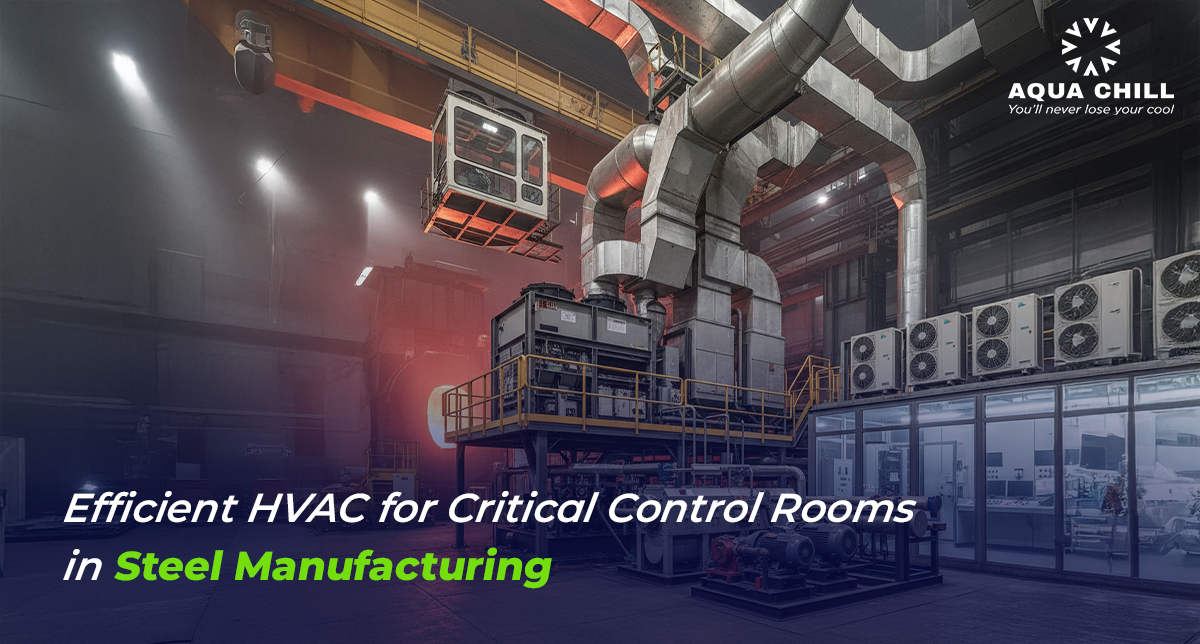
India’s steel sector, which produced 149.6 million tonnes of crude steel in 2024 across over 900 plants, operates under intense environmental conditions. Steel manufacturing generates extreme internal heat, often pushing Electrical Control Room (ECR) ambient temperatures to 50–70°C. These conditions, combined with India’s tropical climate and dust-laden environments, pose a severe threat to sensitive electronics.
Challenges in Steel Plant ECRs
In the steel industry, equipment such as PLCs and VFDs degrade rapidly above 40°C. Without robust centralized cooling, plants face:
- Humidity & Corrosion: High humidity causes condensation on circuit boards, leading to short circuits.
- Dust & Metal Fumes: Conductive dust can settle on components, causing arcing and thermal runaway.
- Production Loss: Unplanned shutdowns from electronic failures account for 15–20% of total mill downtime, costing crores per hour.
The Significance of Water-Cooled Central Chiller Systems
For large-scale steel facilities, water-cooled central air conditioning is the most efficient solution for thermal management. In an industry where Drive Rooms, Panel Rooms, and ECRs require high-capacity, 24/7 cooling, water-cooled chillers outperform air-cooled alternatives in three critical areas:
- Higher Energy Efficiency: Water has a significantly higher heat capacity than air. While air-cooled chillers typically consume around 1.23 kW per ton, water-cooled systems are far more efficient, consuming as little as 0.56 kW per ton. This translates to nearly 50% lower power consumption for the same cooling load.
- Greater Tonnage & Scalability: Water-cooled chillers offer a much higher cooling capacity, ranging from 10 to over 4,000 tons per unit, compared to the 500-ton limit typical of air-cooled systems. This allows a single centralized plant to handle the massive heat loads of multiple drive rooms and high-density panel rooms across a steel mill.
- Stability in High Ambient Temperatures: In steel hubs like Jamshedpur or Bhilai, where outdoor temperatures often exceed 45°C, air-cooled chillers struggle to dissipate heat. Water-cooled systems, utilizing cooling towers, maintain stable performance regardless of the ambient air temperature, ensuring the 22–28°C setpoints required for PLCs and VFDs are never compromised.
In steel plant environments, the choice of HVAC system is critical for both operational reliability and energy costs. Below is a comprehensive comparison of Individual Package AC or VRV (Variable Refrigerant Volume) systems against water-cooled chiller-based air conditioning for industrial applications.
| Feature | Water-Cooled Chiller System | Individual Package AC / VRV |
| Cooling Capacity | Superior: Single units offer 10 to 4,000+ TR. Ideal for massive loads like drive rooms and furnace areas. | Limited: Typically, best for 10–200 TR. Requires many units to match a large industrial load. |
| Energy Efficiency | Highest: Consumes approx. 0.56–0.94 kW/ton. Water transfers heat 10–100x better than air. | Lower: Typically consumes 1.2–1.49 kW/ton. Efficiency drops significantly in high ambient heat. |
| Operational Life | 20–30 years: Components are housed indoors, protected from harsh mill environments. | 10–15 years: Outdoor units (ODUs) are exposed to corrosive dust and extreme heat, accelerating wear. |
| Performance in Heat | Stable: Performance depends on wet-bulb temperature (via cooling towers), which stays lower than dry-bulb air. | Degrades: Efficiency plummets as outdoor temperatures rise above 40°C, a common occurrence in steel plants. |
| Maintenance | Centralized: Maintenance is focused on a single plant room; easier to monitor with an in-house team. | Distributed: Multiple units spread across various locations require individual servicing, increasing labour and downtime risk. |
| Environmental Impact | Lower Carbon Footprint: Higher efficiency directly reduces power-related CO2 emissions. | Higher: Higher energy consumption and greater risk of refrigerant leaks from extensive piping networks. |
Why Water-Cooled Chillers are the Optimal Choice for Steel Mills
While package AC or VRV systems may offer lower initial installation costs, Water-Cooled Chiller systems provide overwhelming benefits for the heavy industrial demands of the steel sector:
- Extreme Load Management: Steel mill Drive Rooms and ECRs generate massive heat gains that VRV systems struggle to dissipate efficiently. A centralized water-cooled chiller handles these high-density loads with a smaller physical footprint inside the plant.
- Protection Against Harsh Environments: In VRV/Package systems, the sensitive outdoor condenser coils are constantly exposed to conductive steel dust and corrosive fumes. In contrast, the heart of a water-cooled chiller (compressors and heat exchangers) remains safely inside a clean mechanical room, ensuring longevity.
- Precision and Reliability: Centralized systems paired with Air Handling Units (AHUs) provide superior humidity and air quality control, which is vital for preventing condensation and corrosion on expensive PLC and SCADA boards.
By prioritizing water-cooled chiller infrastructure, steel plants can ensure consistent cooling performance during peak summer months while slashing their overall power consumption and maintenance overhead.
Strategic Implementation and ROI
Integrating water-cooled chillers into the plant’s infrastructure provides a clear path to operational excellence:
Reduced Footprint: Since water-cooled chillers do not require massive fan arrays for heat rejection, they occupy less indoor space and can be housed in centralized mechanical rooms.
Asset Longevity: By providing a consistent, vibration-free cooling medium, these systems can extend the life of sensitive electronics by 2–3 times.
Operational Reliability: Centralized water-cooled systems are built for 20–30 years of service, providing a more durable and reliable long-term investment than distributed air-cooled units.
Future-Proofing with AI and Sustainability
Modern water-cooled systems are now being integrated with Variable Speed Drives (VSDs) on pumps and compressors. When combined with SCADA-linked sensors, these systems can automatically balance the cooling load between different drive rooms, generating an additional 20–30% efficiency gain and ensuring the plant remains net-zero ready while maximizing industrial throughput.